The 1984 Six-Voice Legend. Meticulously Crafted.
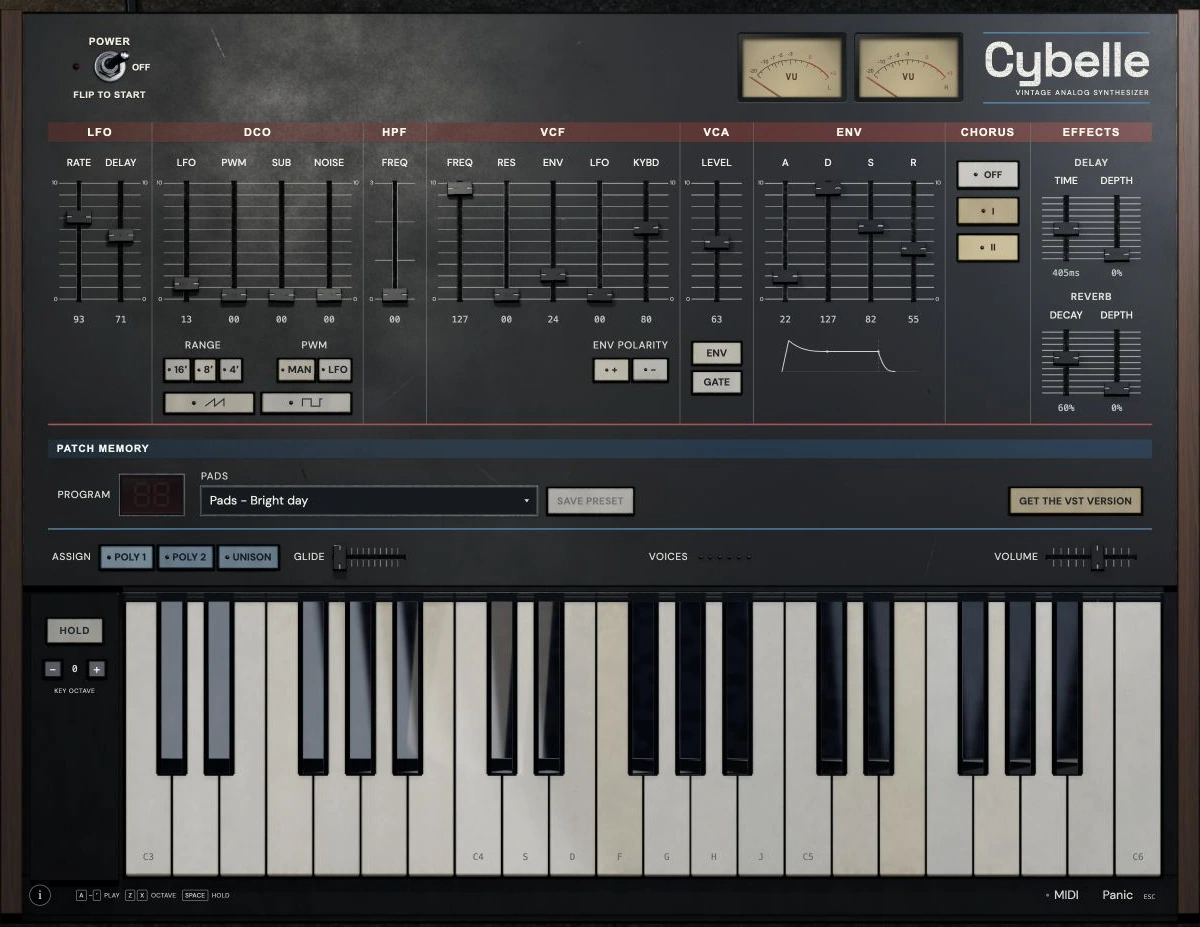
An iconic ’80s polysynth, modeled circuit by circuit. Hear Cybelle beside the hardware original in a blind listening challenge.
The listening test fits your phone. For hands-on sound design, a bigger screen is best.Loading Cybelle…Our existing users have said:
“Cybelle sounds fantastic”
Circuit model
Inside the Cybelle engine
We built Cybelle from the original service schematics and firmware. We compared the model against recordings from our hardware Juno 106.

Oscillators and source mixing
Reduced circuit equations developed with SPICE describe the saw, pulse and sub-oscillator circuitry. The model includes the pulse clamp, sub-oscillator switching and the way the sources load one another at the mixer.
80017A filter and VCA
Cybelle solves the four-pole 80017A low-pass filter’s nonlinear OTA stages together with the resonance feedback. It also models the voltage-controlled amplifier and its control circuit.
Envelope, LFO and DAC timing
The envelope and LFO use lookup tables and integer arithmetic checked against the original ROM bytes. A shared scheduler models the timing of the firmware’s control DAC updates and the values held between them.
Clocked stereo chorus
The chorus uses MN3009-style bucket-brigade delays driven by a modulated clock. The model includes their nonlinear transfer, the filters around the delay lines and the stereo output mix.
Six voices in real time
The C++ engine compiles to WebAssembly and runs in an AudioWorklet. It oversamples stages at different rates and increases the filter’s rate when cutoff and resonance are high.
Blind listening challenge
Hardware or software?
Can you hear the difference between the hardware original and Cybelle? Seven blind rounds pair the same patches and performances at matched loudness.
How the recordings were made
Recordings of our vintage hardware reference are paired with Cybelle renders made with the captured patch settings and MIDI timings.
Both sources use the same integrated loudness target, matched by constant gain with true-peak headroom. Stereo is preserved. The edits are limited to trimming, constant latency alignment and short edge fades. The hardware’s voice and modulation phases run independently.
Cybelle VST
Bring Cybelle into your DAW
The plug-in is in development. It will bring the sound of the browser instrument to your own projects.
Planned price $50
Questions?
How do I play Cybelle?
Flip Cybelle’s power switch, then use the on-screen piano or the letter keys on your computer. You can also connect a MIDI keyboard in a browser that supports Web MIDI.
What can I do on a phone?
You can take the listening challenge, sign up for Cybelle VST updates, or open the full instrument. A larger screen gives you more room to play.
When can I get the Cybelle VST?
Development is underway. You can join the launch list to get an email when it’s ready.